
Jump&Run
Run. Jump. Fly. Compete.
A human-powered aerial race where every jump, sprint, and glide is earned by the rider.
- Human-Powered Movement — every burst of speed comes from the rider, not a motor
- Gravity-Propelled Trolley — lightweight, forward-only, up to 20 km/h
- Solo or Competitive — single rides, parallel racing, timed challenges
- Indoor & Outdoor — flat loops, inclined descents, any venue type
- Modular Obstacles — customizable sequence and difficulty
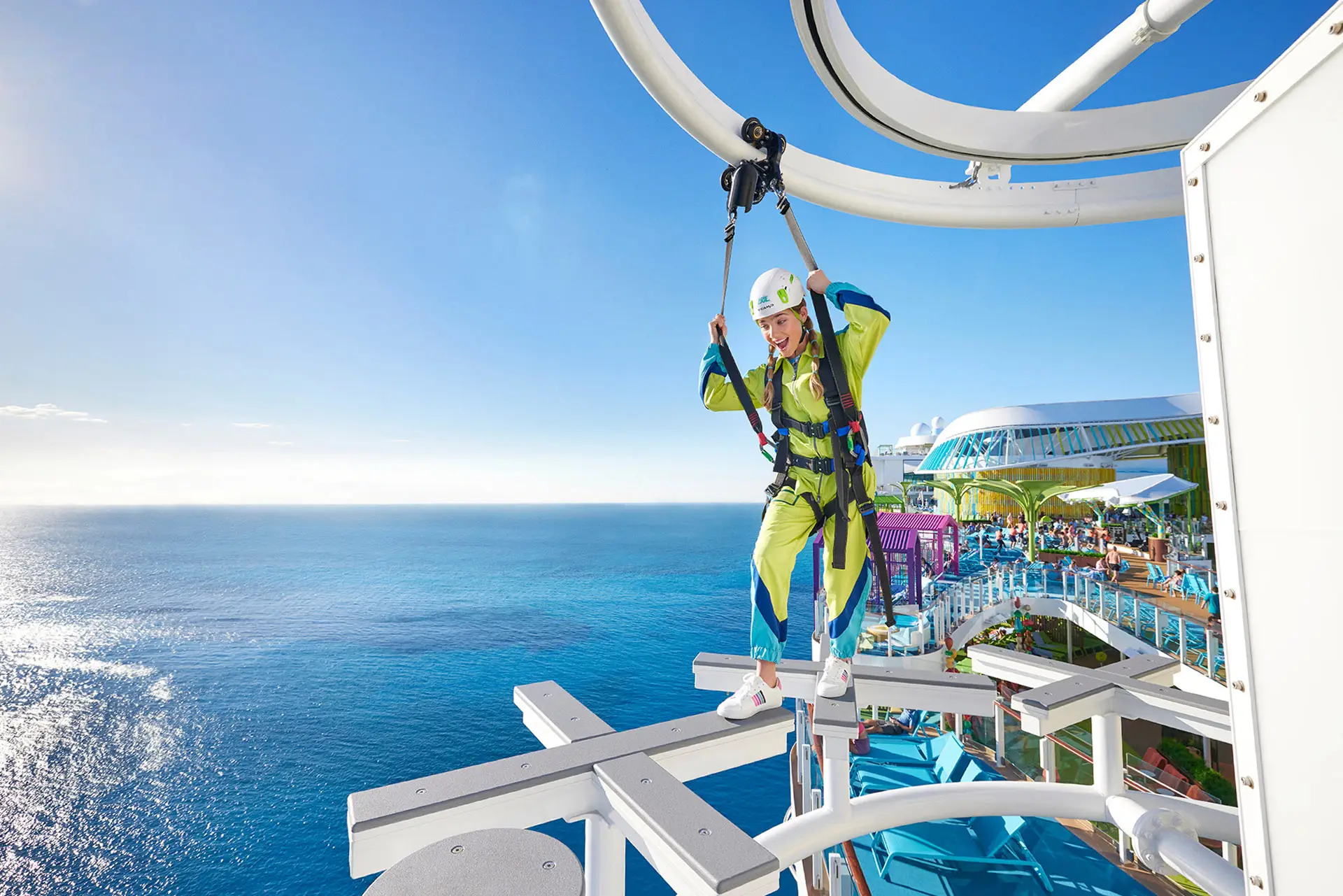
Jump&Run is an active, human-powered ride where participants advance along a suspended track by running, jumping, and gliding. Every burst of speed and every moment of free glide is driven by the rider's own effort — a physical experience that feels earned, not passive.
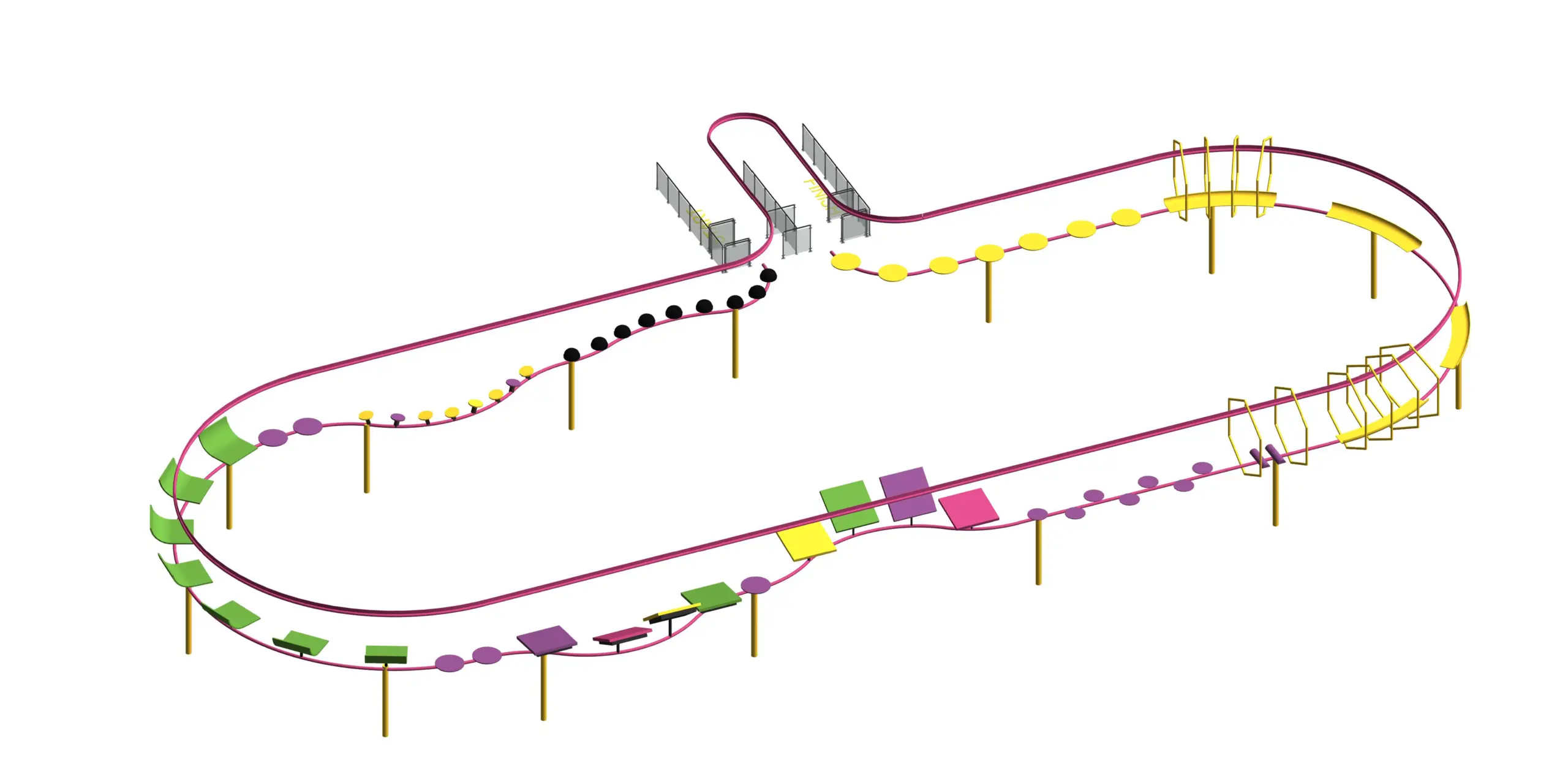
The attraction comes in two track configurations. The Gravitational Loop uses an inclined track where riders climb, tackle obstacles, and descend in gravity-assisted glide — ideal for venues with ceiling height or outdoor elevation. The Horizontal Loop runs flat, with riders generating all forward motion themselves and dual parallel tracks for head-to-head racing — suited to standard indoor spaces. Both adapt to virtually any venue and deliver the kind of visible, energetic spectacle that pulls crowds and drives repeat visits.


1
2
3
3
3
4
5
5
6
7
8
9
Obstacle Types
- Bosu Bounce — inflated dome platforms; riders push off and jump between them, balancing on the unstable surface
- Incline Rush — angled platforms stepping upward; riders drive themselves up with short, fast steps
- Pod Hop — small round platforms at intervals; riders jump pod to pod without touching the ground
- Wave Flow — curved platforms following an arc; riders run along the turn, leaning into the curve
- Swing Run — laterally offset platforms; riders step side to side while progressing forward
- Speed Steps — rapid zig-zag sequence; riders alternate feet with fast, precise footwork
- Ring Run — vertical rings mounted along the track; riders pass through without breaking stride
- Hop Steps — rounded step platforms in sequence; riders hop forward in a steady rhythm
- Balance Flow — platforms with wider gaps; riders slow down, stabilize, and reach for the next
Jump&Run – Technical Specifications
| Single Line | Single Line + Platform | Double Race Line | |
|---|---|---|---|
| Capacity & Staffing | |||
| Throughput | Up to 60 ppl/h | Up to 120 ppl/h | Up to 240 ppl/h |
| Intermediate platforms | — | ✔ | ✔ |
| Parallel / race lines | Single | Single | Double or triple |
| Operators required | 1 | 1–2 | 1–2 |
| Timer system (optional) | ✔ | ✔ | ✔ |
| Track & Structure | |||
| Track material | Steel (S235 or higher; JR, J0 or J2) | ||
| Track profile | Circular hollow section 108 × 5(6) mm + vertical rail 120 × 6 mm | ||
| Surface treatment | Primed & painted / Hot-dip galvanized / Duplex coating | ||
| Corrosion resistance | Up to C5 category | ||
| Minimum turn radius | 6 m | ||
| Transition curves | ✔ Between all turns for smooth ride experience | ||
| Min. recommended track length | 80 m | ||
| Track gradient (Gravitational Loop) | 4–7% | ||
| Safety clearance — lateral | 2 m from both sides of the track | ||
| Safety clearance — vertical | 2.35 m | ||
| Platforms | |||
| Start / finish platform | ✔ Single platform | ✔ Single platform | ✔ Single platform |
| Platform footprint | 17 m² | ||
| Finish platform height | 2.50 m | ||
| Min. clear height (standard) | 5.80 m | ||
| Min. clear height (trampoline parks) | 8.20 m | ||
| Min. clearance: platform to ceiling | 3.00 m | ||
| Power supply | 2 kW, monophase, 220V, 50–60 Hz | ||
| Trolley & Harness | |||
| Trolley type | Gravity-propelled, forward-only motion | ||
| Trolley weight | 8 kg | ||
| Maximum speed | 20 km/h | ||
| Harness | Full Body Harness with adjustable lanyards | ||
| Rider height | 120 – 200 cm | ||
| Rider weight | 30 – 120 kg | ||
| Automation & Safety | |||
| Traffic control system | ✔ Integrated, with traffic light at ride start | ||
| Easy-open track segment | ✔ For trolley access, with integrated parking position | ||
| Compliance | EN 13814 | ||
| Certifications | TÜV, ASTM & CSEI certified | ||
| Track Configurations | |||
| Gravitational Loop (inclined track) | ✔ | ✔ | ✔ |
| Horizontal Loop (flat track) | ✔ | ✔ | ✔ |
| Obstacles along track | ✔ | ✔ | ✔ |
| Indoor installation | ✔ | ✔ | ✔ |
| Outdoor installation | ✔ | ✔ | ✔ |
| Start from mezzanine | ✔ | ✔ | ✔ |
| Start from dedicated platform | ✔ | ✔ | ✔ |
| Compatible Attractions | |||
| Ropes Course | ✔ | ✔ | ✔ |
| Net Maze | ✔ | ✔ | ✔ |
| Playgrounds | ✔ | ✔ | ✔ |
| Special Options | |||
| LED-lighted track & obstacles | ✔ | ✔ | ✔ |
| UV fluorescent track (blacklight glow) | ✔ | ✔ | ✔ |
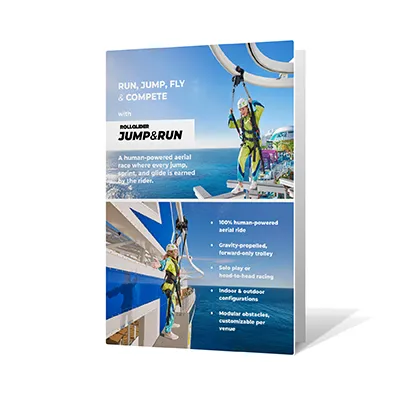
Gravitational Loop
Inclined track with dynamic ascent & glide
Riders climb via inclined platforms, navigate obstacles on the way up, and descend in gravity-assisted free glide. The 4–7% gradient creates a visible, dramatic ride that alternates between physical effort and rewarding stretches of flight.
Best suited for:
- adventure parks
- outdoor leisure destinations
- venues with high ceilings or multi-level structures
- trampoline parks
- trampoline parks
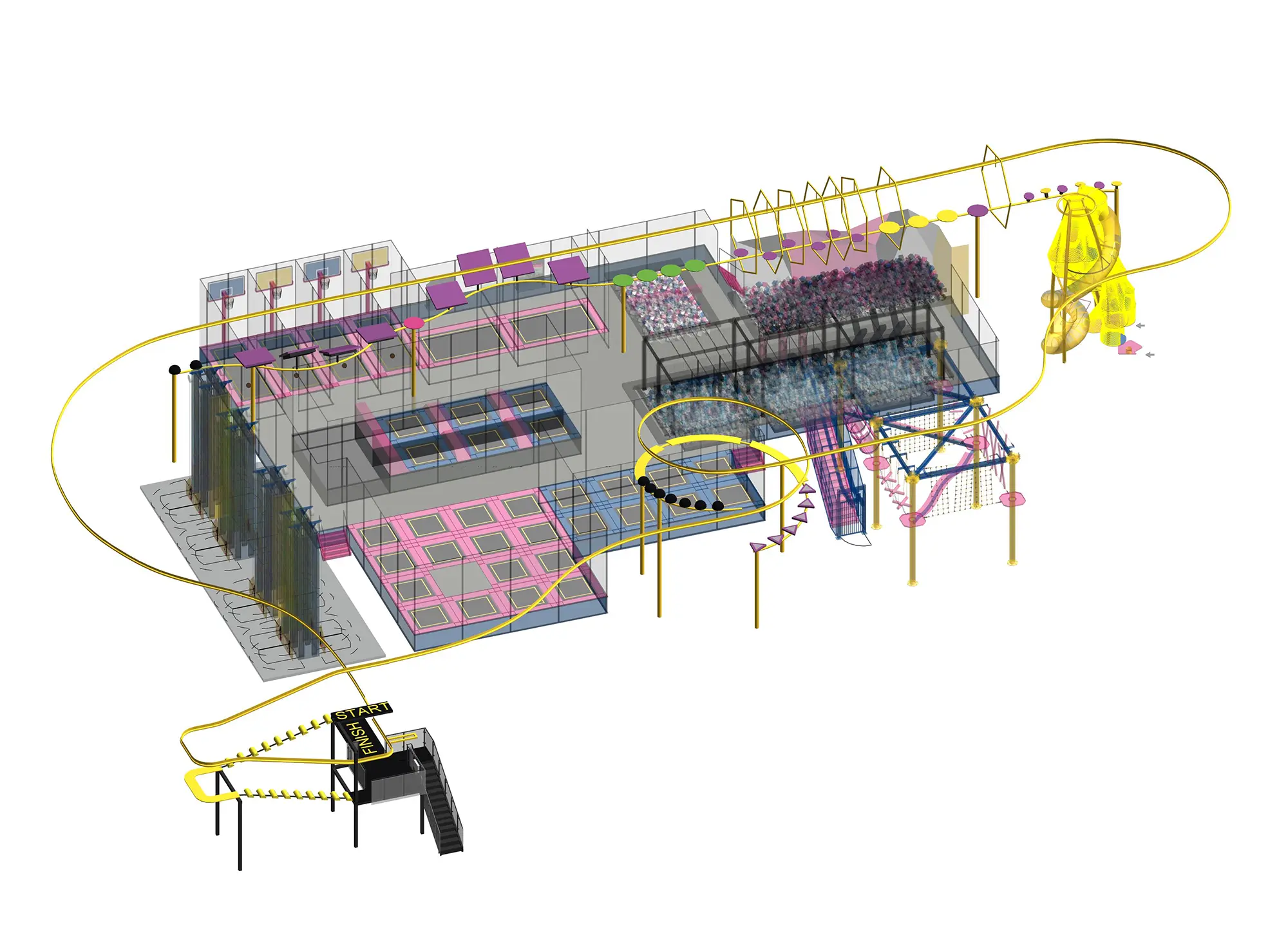
Track Comparison
| Gravitational Loop | Horizontal Loop | |
|---|---|---|
| Track layout | Inclined, 4–7% gradient | Flat or near-flat |
| Motion | Climb + gravity-assisted glide | Sprint + suspended glide |
| Parallel racing | Optional | Standard (dual lines) |
| Min. clear height | 5.80 m+ | 5.80 m |
| Best suited for | Adventure parks, resorts, multi-level venues | FECs, shopping malls, trampoline parks |
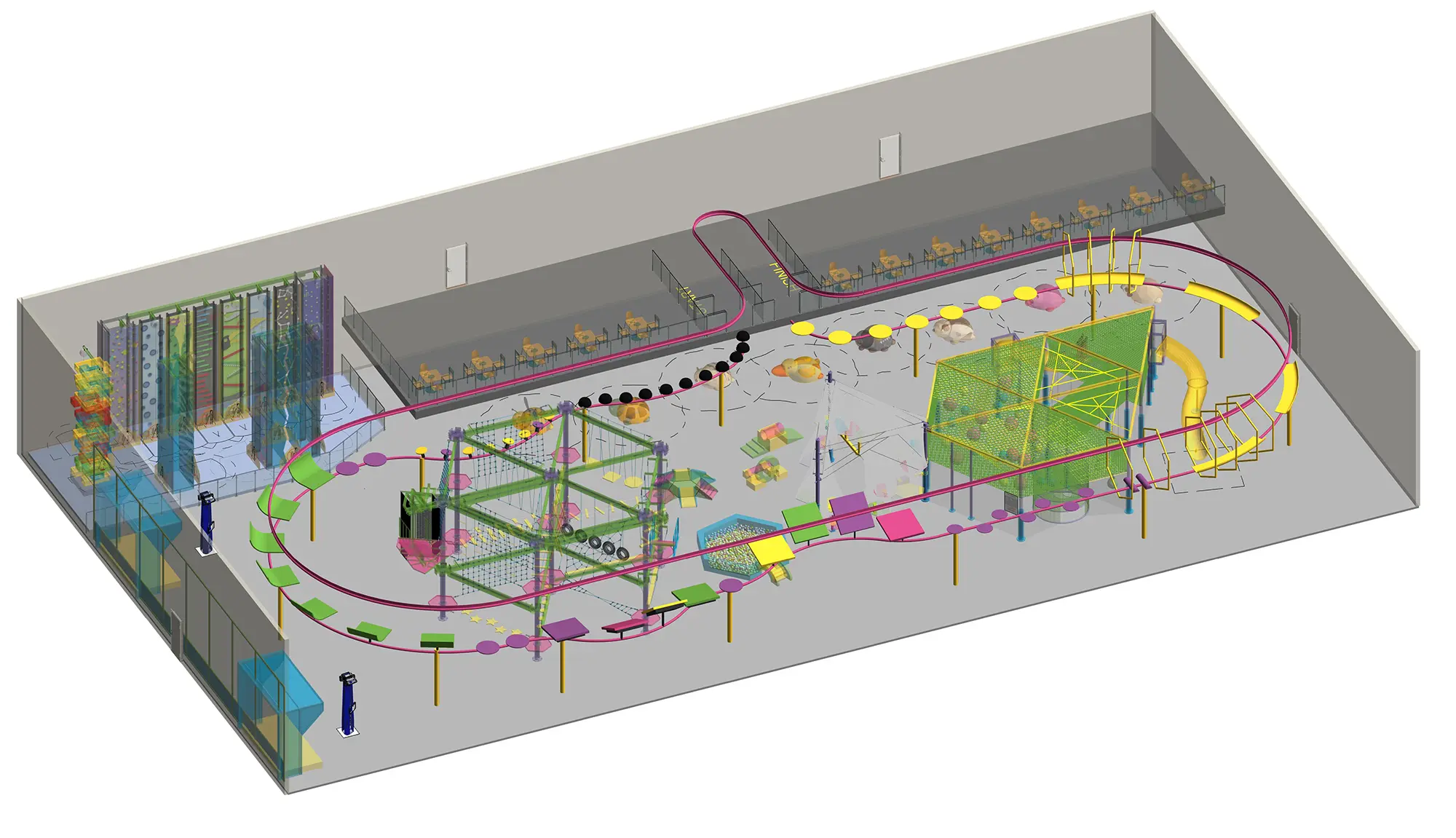
Horizontal Loop
Flat track focused on speed & flow
Riders generate all forward motion themselves — sprinting across platforms, leaping between obstacles, then hanging from the trolley to glide to the next challenge. The flat oval layout supports dual parallel tracks for head-to-head racing with a single shared start/finish platform.
Best suited for:
- FECs
- shopping malls
- indoor adventure parks
- trampoline parks
- compact urban venues
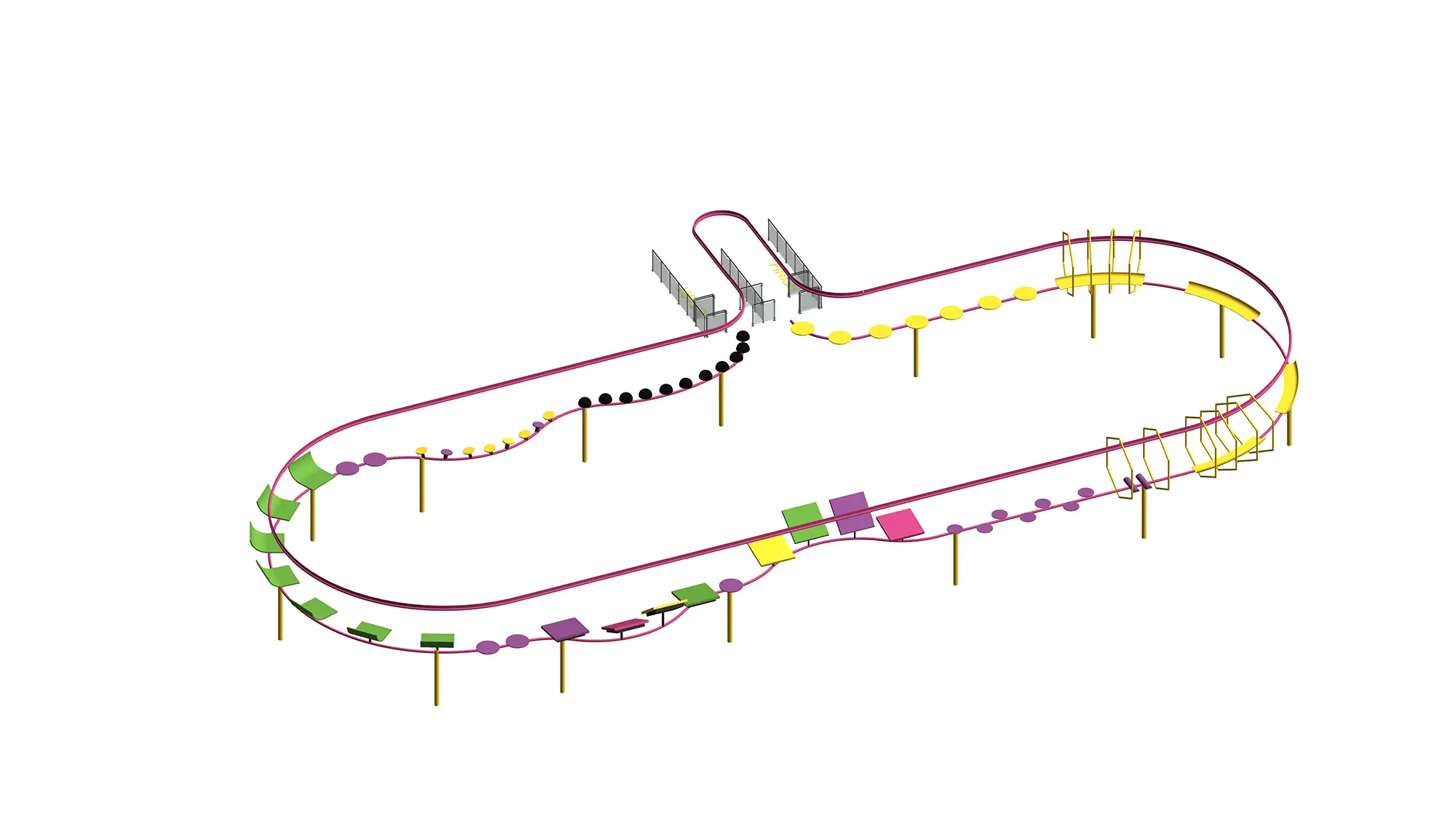
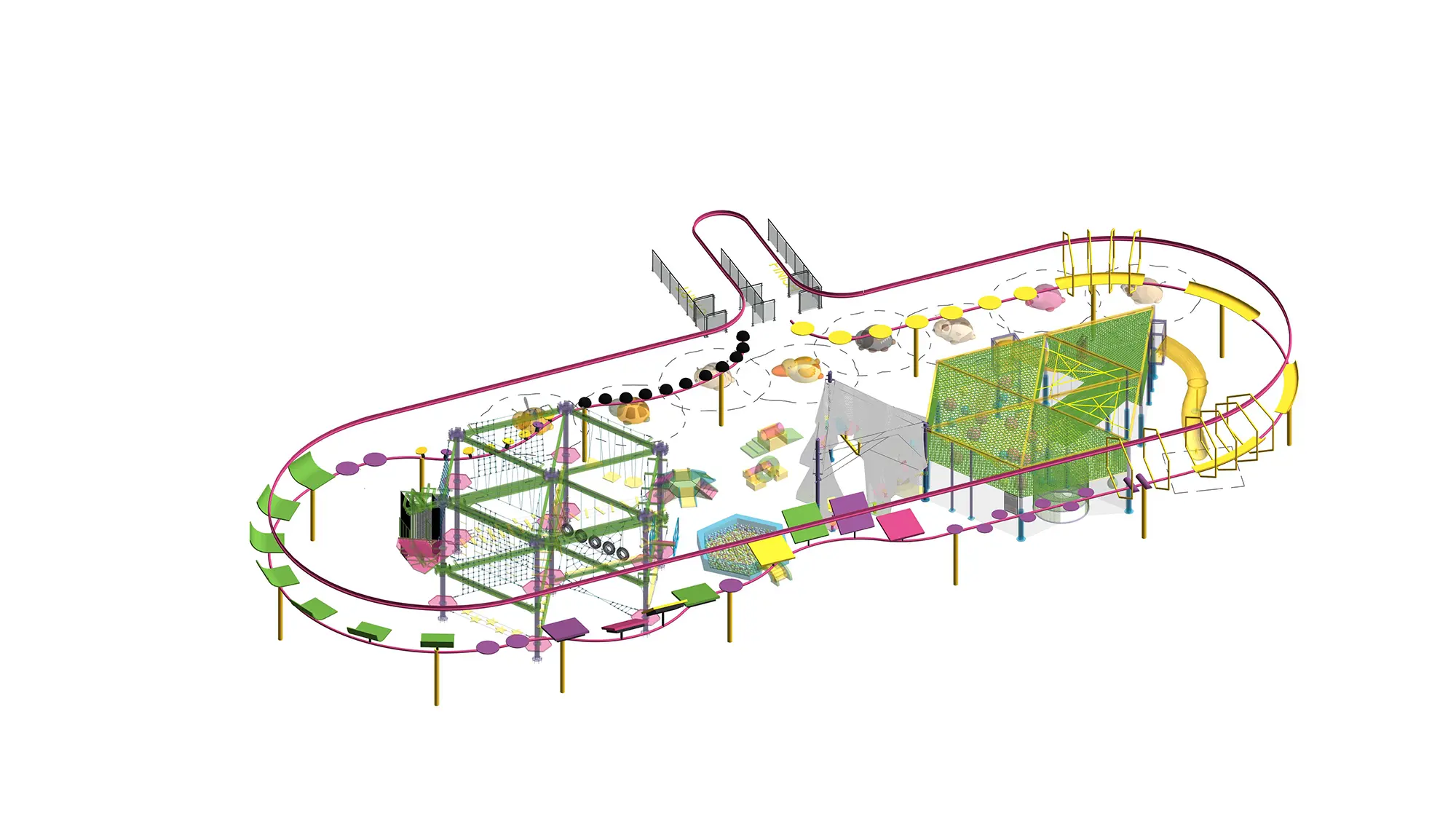
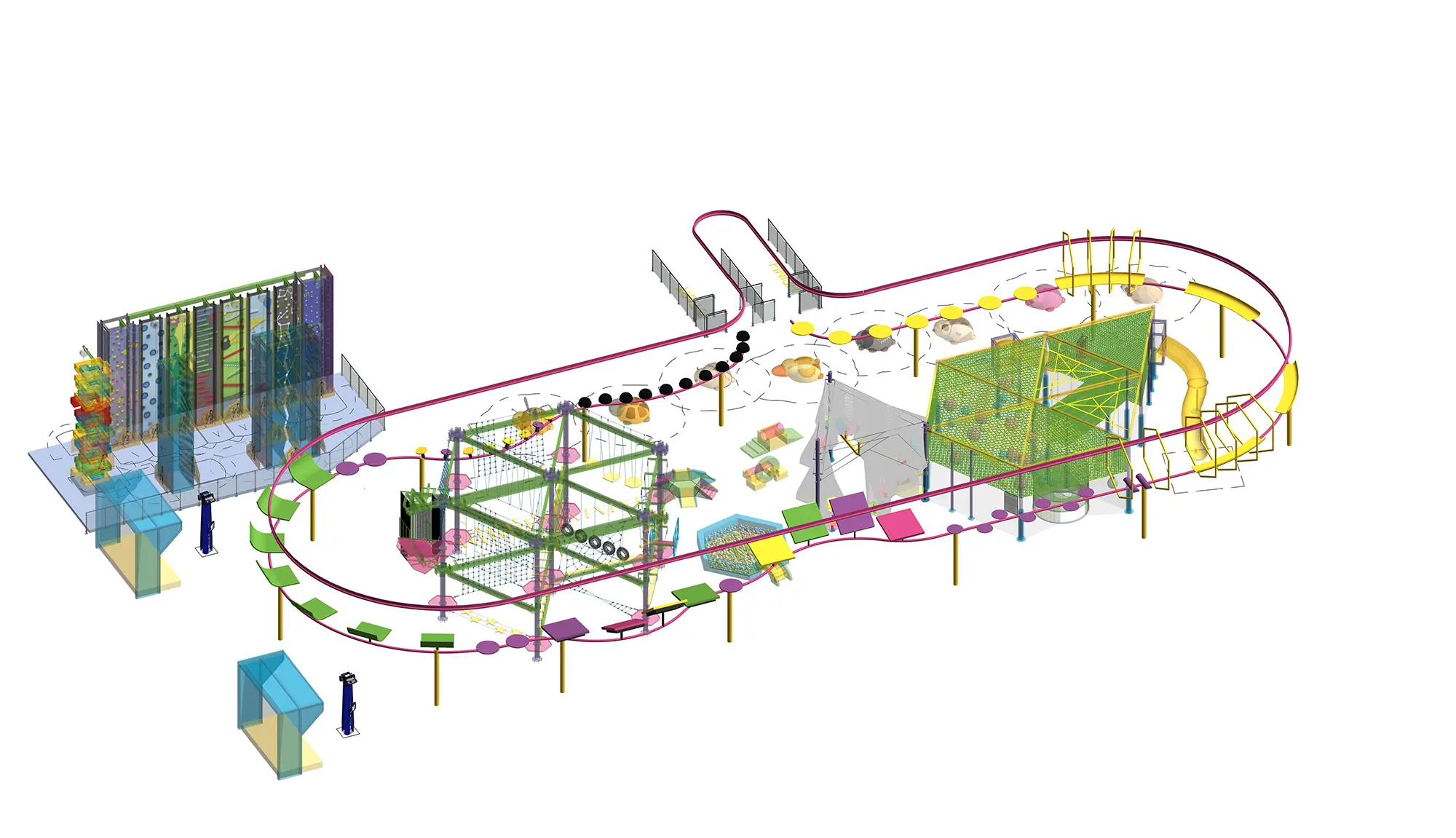
Track Comparison
| Gravitational Loop | Horizontal Loop | |
|---|---|---|
| Track layout | Inclined, 4–7% gradient | Flat or near-flat |
| Motion | Climb + gravity-assisted glide | Sprint + suspended glide |
| Parallel racing | Optional | Standard (dual lines) |
| Min. clear height | 5.80 m+ | 5.80 m |
| Best suited for | Adventure parks, resorts, multi-level venues | FECs, shopping malls, trampoline parks |

